
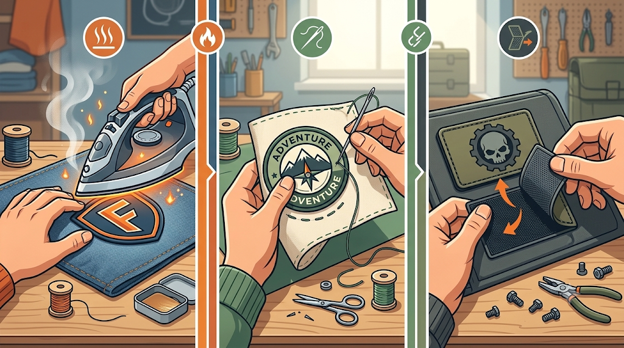
Picking a patch design is the fun part. Picking the backing is the part that decides whether your patch survives the wash, the wear, and the years ahead. Custom patches can be attached in three main ways: ironed on with heat-activated adhesive, sewn on with thread, or fixed with a velcro (hook and loop) backing that lets you swap patches whenever you like.
Each method has its own strengths, and the right one depends on the fabric, how often the item is worn or washed, and how permanent you want the patch to be.
This guide breaks down the iron on vs sew on patches debate in plain terms, explains exactly how velcro patch backing works, and walks through which option suits jackets, uniforms, caps, bags, and tactical gear. By the end, you will know precisely which backing to choose and why.
Iron-On vs Sew-On vs Velcro Backing
| Factor | Iron-On | Sew-On | Velcro (Hook & Loop) |
| Application | Heat press or household iron | Needle and thread, or machine sewing | Hook piece sewn on, patch attaches via loop |
| Durability | Moderate | Highest | High, but hook/loop wears with heavy use |
| Removable/Swappable | No | No (without unpicking stitches) | Yes, instantly |
| Skill Needed | Low | Moderate | Low, but hook still needs sewing on once |
| Best Fabrics | Cotton, denim, polyester blends | Almost any fabric, including leather | Uniforms, bags, tactical vests |
| Wash Durability | Good, may lift at edges over time | Excellent | Good if hook is sewn, not just stuck on |
| Typical Cost | Lowest | Slightly higher (labour) | Moderate (extra hook material) |
What Is Iron-On Patch Backing?
An iron-on patch has a layer of heat-activated adhesive on the back. Press it with a household iron or a heat press for 20 to 40 seconds, and the glue melts into the fabric fibres, bonding the patch in place as it cools. It is the fastest way to apply a patch, which is why so many iron-on patches end up on jackets, hoodies, tote bags, and school uniforms where speed and a clean finish matter more than a lifetime guarantee.
Pros of Iron-On Backing
- Fastest application method, ready in under a minute
- No sewing skills or equipment required
- Clean, flat finish with no visible stitching
- Lower cost than sew-on production
Cons of Iron-On Backing
- Not recommended for leather, nylon, waterproof, or heat-sensitive fabrics
- Edges can lift after repeated washing or heavy wear
- Permanent bond, so the patch cannot be moved or reused
- Best reinforced with a few stitches around the border for long-term wear
What Is Sew-On Patch Backing?
Sew-on backing is the traditional method: the patch has a plain fabric back, and it is stitched directly onto the garment by hand or machine. There is no adhesive involved, so the bond depends entirely on the thread. This makes sew-on patches the go-to choice for items that face heavy daily wear, frequent washing, or professional inspection, such as military uniforms, workwear, motorcycle jackets, and varsity jackets.
Pros of Sew-On Backing
- Most durable attachment method, holds through years of washing
- Works on virtually any fabric, including leather and canvas
- No risk of heat damage during application
- Preferred for official uniforms and formalwear where a stitched look is expected
Cons of Sew-On Backing
- Takes longer to apply than an iron-on patch
- Requires a needle and thread, a sewing machine, or a tailor
- Removing the patch later means unpicking every stitch
What Is Velcro (Hook and Loop) Patch Backing?
Velcro patch backing uses two matching strips: a soft loop strip sewn onto the garment or gear, and a rough hook strip attached to the back of the patch. Press the two together and the patch stays firmly in place until you decide to peel it off. This is the only backing of the three that lets you change, rotate, or remove patches without touching a needle or an iron every time.
Because the loop side is permanently sewn on and the hook side simply presses into it, velcro backing is standard on tactical vests, police and military uniforms, backpacks, and any gear where patches need to be swapped for different roles, ranks, or seasons.
Pros of Velcro Backing
- Instantly removable and interchangeable, ideal for rotating logos or ranks
- No heat or repeated sewing needed once the loop panel is in place
- Great for uniforms, tactical gear, backpacks, and promotional apparel
- Protects the patch itself, since it can be taken off before washing
Cons of Velcro Backing
- The loop panel still needs to be sewn onto the garment first
- Hook and loop fibres can wear down or collect lint over years of use
- Adds slight bulk compared to a flat sew-on or iron-on finish
- Patches can be lost if they are not pressed on firmly
Iron-On vs Sew-On Patches: The Key Differences
When people search iron on vs sew on patches, they are usually deciding between speed and permanence. Here is how the two compare side by side on the details that matter most.
| Comparison Point | Iron-On Patches | Sew-On Patches |
| Application time | Under a minute with a heat press | Several minutes per patch, by hand or machine |
| Permanence | Semi-permanent, adhesive can weaken over time | Permanent until stitches are removed |
| Fabric restrictions | Avoid leather, nylon, and waterproof shells | Works on almost any fabric type |
| Wash resistance | Good for occasional washing | Excellent, holds through frequent washing |
| Ideal use case | Casual apparel, fast turnaround events, retail add-ons | Uniforms, outerwear, workwear, heirloom garments |
When Velcro Backing Is the Best Choice
Velcro backing is not about durability alone, it is about flexibility. Choose it whenever a patch needs to move between garments, come off before a wash, or be swapped for a different design without damaging the fabric underneath.
- Military, police, and security uniforms where rank or unit patches change
- Tactical vests, backpacks, and duffel bags with rotating gear
- Seasonal or promotional apparel where branding changes throughout the year
- Kids’ backpacks and jackets where patches get swapped often
- Any item that needs frequent washing and the patch needs to come off first
Factors to Consider Before Choosing a Patch Backing
1. Fabric Type
Delicate, waterproof, or heat-sensitive fabrics such as nylon shells, leather, and technical outerwear should avoid iron-on adhesive, since high heat can scorch or warp the material. Sew-on and velcro backings are safer for these fabrics.
2. Wash Frequency
Items washed weekly, such as workwear or school uniforms, hold up best with sew-on backing. If the patch needs to come off before every wash, velcro is the more practical option.
3. How Often the Patch Will Change
A one-time logo placement suits iron-on or sew-on. A patch that represents rank, role, or a rotating campaign belongs on velcro.
4. Budget and Turnaround
Iron-on is the most cost-effective and fastest to produce in bulk, while velcro backing adds a small amount to production cost because of the extra hook and loop material. We covered how these choices interact with patch borders, materials, and finishes in our breakdown of custom patch types, backings, and borders, which is worth a read if you are still weighing up the full range of options.
Best Patch Backing by Use Case
| Item / Use Case | Recommended Backing | Why |
| Leather jackets | Sew-on | Heat can damage leather, stitching holds securely |
| Denim jackets and vests | Iron-on or sew-on | Denim tolerates heat well and holds stitching easily |
| Military and tactical gear | Velcro | Patches need to be swapped for rank or mission |
| Corporate uniforms and workwear | Sew-on | Withstands daily wear and frequent washing |
| Caps and hats | Sew-on or iron-on | Curved surfaces hold embroidery well with either method |
| Backpacks and duffel bags | Velcro | Bags see rough use and benefit from removable patches |
| Event or promotional apparel | Iron-on | Fast turnaround for large quantities |
The base patch material also affects how well each backing performs. Embroidered patches take iron-on, sew-on, or velcro backing equally well, while thicker PVC patches are almost always finished with sew-on or velcro because their rubber-like texture does not bond as reliably with iron-on adhesive.
If you are outfitting caps specifically, the raised texture discussed in our guide to puff embroidery for hats and heavywear pairs well with a sew-on finish for a clean, long-lasting result.
How to Apply Each Type of Patch Backing
Applying an Iron-On Patch
- Set the iron to a high, dry heat setting with no steam
- Place the patch adhesive-side down on the fabric and cover with a thin cloth
- Press firmly for 25 to 40 seconds, moving in small circles rather than sliding
- Let the patch cool fully before checking the edges for a secure bond
Applying a Sew-On Patch
- Pin the patch in place to stop it shifting while you work
- Use a strong polyester thread that matches or complements the patch border
- Stitch around the entire perimeter with small, even stitches, going through the garment each time
- Knot off securely on the inside of the fabric so no loose thread shows
Applying Velcro Backing
- Sew the loop strip onto the garment first, stitching all four sides for a secure hold
- Press the hook side of the patch firmly onto the loop panel
- Check the patch sits flat with no gaps between the hook and loop layers
- Store spare patches away from lint and pet hair, which can clog the hook fibres over time
Can You Combine Backing Types?
Yes. Many customers choose a hybrid approach for the best of both worlds. A common combination is iron-on adhesive with a stitched border, which speeds up placement while adding extra hold at the edges where patches usually start to lift.
Another popular option is a velcro-backed patch that also ships with a spare loop panel, so the same patch can be moved between two different jackets or bags.
If you are ordering in bulk for a team, uniform, or retail line, it is worth discussing hybrid backing with your supplier before production begins, since switching backing types after manufacturing is far more expensive than specifying it upfront.
Frequently Asked Questions
Is iron-on or sew-on better for patches?
Sew-on backing is more durable and better for items that are washed often or worn daily, such as uniforms and workwear. Iron-on backing is faster and more affordable, making it a better fit for casual apparel, promotional items, and one-off events.
Does velcro patch backing damage clothing?
No, as long as the loop panel is sewn on properly rather than glued. The stitching sits on the garment, not the hook and loop material itself, so removing a velcro patch does not damage the fabric underneath.
Can iron-on patches also be sewn on for extra durability?
Yes. Many people iron a patch on first for placement and then add a few stitches around the border. This combination speeds up application while giving the patch the long-term hold of sew-on backing.
How long do iron-on patches actually last?
With proper application and moderate washing, iron-on patches typically last one to two years before the edges start to lift. Hand washing or turning the garment inside out before a machine wash extends this significantly.
Is velcro patch backing machine washable?
Yes, as long as the hook and patch are separated before washing. Washing them together can cause the hook fibres to snag on other fabrics in the load.
Which backing is best for leather jackets and bags?
Sew-on backing is the safest choice for leather, since the iron’s heat can scorch or discolour the material. Velcro is also an option if the leather item needs the patch to be removable.
Can a sew-on patch be removed without damaging the fabric?
It can be removed by carefully unpicking the stitches with a seam ripper, though this takes more time and care than removing an iron-on or velcro patch, and small needle marks may remain.
What is the strongest patch backing overall?
Sew-on backing offers the strongest, most permanent hold across the widest range of fabrics, which is why it remains the standard for military, workwear, and heirloom garments.
Choosing the Right Patch Backing for Your Project
There is no single best backing, only the best backing for your specific fabric, wear pattern, and how often the design needs to change. Choose iron-on for speed and affordability on casual apparel, sew-on for maximum durability on uniforms and outerwear, and velcro when patches need to be swapped, rotated, or removed before every wash. Matching the backing to the job is what makes a custom patch look sharp on day one and still hold up years later.
Still unsure which backing fits your order? Get in touch with our team through the contact page and we will help you choose the right combination of material, size, and backing for your project.