
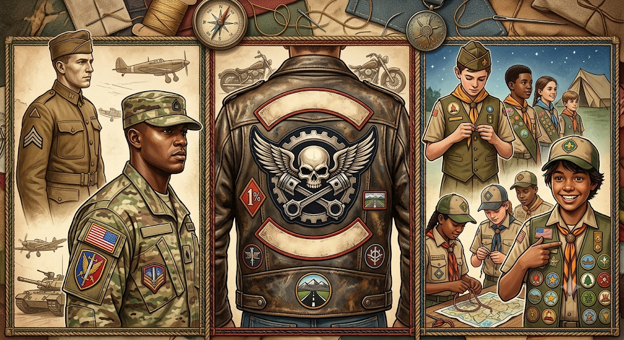
A patch is never just fabric and thread. It is a badge of belonging, a record of achievement, and sometimes a warning to stay away. From the battlefield to the biker rally to the scout campfire, patches have carried meaning for over a century. Understanding the history of patches helps explain why they still matter today, and why people wear them with so much pride.
This guide walks through where patches came from, what military and biker patches actually mean, why bikers wear patches at all, and how scout culture turned badges into a system of personal growth.
A Brief History of Patches: From Battlefields to Backpacks
Cloth badges and insignia go back centuries, but the patch as we know it today, an embroidered or woven emblem sewn or ironed onto fabric, took shape in the 19th and early 20th centuries. Armies needed a fast way to identify soldiers by unit, rank, and role without relying on spoken language or paperwork. Cloth was cheap, durable, and easy to produce in bulk, which made it the natural choice for military identification.
World War I and World War II
The First World War is widely credited with popularising the modern shoulder sleeve insignia. Divisions adopted colourful, symbolic designs so soldiers could be identified at a glance, even from a distance or in poor visibility.
By the Second World War, patches had become a full identification system across nearly every branch of service, covering divisions, squadrons, campaigns, and specialist qualifications. Pilots and aircrew added their own patches, often designed by the unit itself, which introduced a more personal and creative element to what had started as a purely functional tool.
Patches Enter Civilian Life
After both world wars, returning veterans carried the culture of patches into civilian life. Motorcycle clubs, many founded by ex-servicemen, adopted the same sewn-badge system to show club membership and rank.
Around the same time, scouting organisations formalised merit badge programmes that used patches to mark skills learned and milestones reached. What began as a military necessity became a shared visual language across three very different worlds: the armed forces, the open road, and youth development.
Meanings of Military Patches: What Every Symbol Represents
Military patches are rarely decorative. Every colour, shape, and symbol is chosen deliberately, and most carry a specific meaning tied to unit history, rank, or achievement. Below is a breakdown of the meanings of military patches by category.
Unit and Regiment Patches
Unit patches identify which division, regiment, or squadron a service member belongs to. Symbols often reference the unit’s history, a nickname earned in combat, or a geographic connection to where the unit was formed. These patches build identity and pride, and losing the right to wear one is treated as a serious matter within military culture.
Rank and Qualification Patches
Chevrons, stripes, and specialist badges show rank and training. A parachutist wears jump wings, a marksman wears a shooting badge, and senior enlisted personnel wear chevrons that indicate years of service and leadership responsibility. These patches function almost like a resume stitched onto a uniform, communicating experience at a glance.
Morale Patches
Not every military patch is official. Morale patches are informal, often humorous or unit-specific designs worn on gear rather than the dress uniform. They build camaraderie and let personality show through in an otherwise standardised uniform system.
| Patch Type | Worn On | What It Represents |
|---|---|---|
| Unit / Division Patch | Shoulder sleeve | Which unit or division a service member belongs to |
| Rank Chevron | Upper sleeve or collar | Rank and seniority |
| Qualification Badge | Chest | Specialist skill, such as parachutist or marksman |
| Service Stripe | Lower sleeve | Years of service completed |
| Morale Patch | Tactical gear or backpack | Informal unit identity or humour |
The Meaning of Biker Patches: Reading the Language of the Road
Biker patches follow their own strict code, and reading a motorcycle vest correctly tells you a great deal about the rider and the club they represent.
The Three-Piece Patch System
Most motorcycle clubs use what is known as the three-piece patch system on the back of a vest, often called a cut. The top rocker names the club, the centre patch displays the club’s logo or symbol, and the bottom rocker states the chapter’s location. Together, these three patches confirm identity, affiliation, and territory in a single glance.
Colors, Rockers, and MC Symbols
Within motorcycle culture, the full patch set worn on a vest is often referred to as colors. Additional small patches, sometimes called rockers or flashes, can indicate a rider’s role in the club, such as president, road captain, or sergeant at arms.
Some patches also mark years of membership, specific achievements, or events attended. Because these patches represent earned status, wearing a patch that has not been earned is considered a serious breach of biker etiquette.
Why Do Bikers Wear Patches?
Bikers wear patches for the same core reasons military units always have: identity, loyalty, and communication without words. A patch instantly tells other riders which club someone belongs to, what chapter they represent, and often how long they have been part of that community.
For many riders, earning a patch is a milestone that reflects trust built over time, not something handed out casually. Patches also carry a protective function, since a recognisable set of colors signals which group a rider is affiliated with in situations where that matters.
Scout Culture and Patches: Badges of Achievement
Merit Badges and What They Teach
Scouting organisations use patches, commonly called merit badges, to mark specific skills a young person has learned, from first aid to camping to community service. Each badge represents hours of learning and a demonstrated skill, which is why scouts often display their sash or vest with visible pride. The system turns personal development into something tangible and wearable.
Council and Event Patches
Beyond merit badges, scouts also collect council patches, jamboree patches, and event patches that mark specific troops, camps, or gatherings attended. These patches function more like a travel journal than a skills record, documenting where a scout has been and which community they belong to.
Military vs Biker vs Scout Patches: A Side-by-Side Comparison
| Aspect | Military Patches | Biker Patches | Scout Patches |
|---|---|---|---|
| Purpose | Identify unit, rank, qualification | Show club identity, status, loyalty | Mark skills learned and events attended |
| Earned or Issued | Mostly issued by rank or role | Earned through membership and trust | Earned by completing requirements |
| Placement | Uniform sleeve, chest | Vest or jacket, back and front | Sash, vest, uniform shirt |
| Common Materials | Embroidered, woven | Embroidered, chenille for larger designs | Embroidered |
| Cultural Weight | Formal, regulated | Informal but strictly self-policed | Educational and celebratory |
Common Patch Symbols and What They Mean
Across military, biker, and scout patches, certain symbols repeat again and again because they carry meaning that translates across cultures and generations. Recognising these symbols makes it easier to understand a patch at a glance, whether it is stitched onto a uniform, a vest, or a sash.
| Symbol | Common Meaning |
|---|---|
| Eagle | Freedom, national pride, or elite status within a unit or club |
| Skull | Mortality, toughness, or a warning not to be underestimated |
| Wings | Aviation service, speed, or a qualification such as parachute training |
| Stars | Rank, achievement level, or years of service or membership |
| Crossed Rifles or Swords | Combat arms, infantry heritage, or a military specialty |
| Diamond or Rhombus | In biker culture, often signals a rider’s self-declared status within outlaw motorcycle circles |
| Anchor | Naval service or a maritime connection |
| Flame or Torch | Guidance, knowledge, or a scouting ideal such as enlightenment through learning |
Colour choice adds another layer of meaning on top of the symbol itself. Black and gold often signal formality and achievement, red is frequently used for combat units or high-risk roles, and muted greens and browns are common where a design needs to stay understated on tactical gear. Biker clubs typically choose colours that stand out clearly at a distance, since a vest needs to be identifiable from across a car park or a rally ground.
How Patch Materials Influence Meaning and Durability
The material a patch is made from is not just an aesthetic choice, since it can affect how long a patch lasts and how formal it looks. Traditional embroidered patches remain the most widely used option across military, biker, and scout culture because raised thread detail is durable and instantly recognisable.
Choosing between the various patch types and backings available makes a real difference in how long a design holds up on a vest, jacket, or uniform, since backing choice affects both attachment method and finished look.
For riders and veterans who prefer a no-sew option, iron on patches offer a fast way to attach a design to a jacket or vest without needing a needle and thread, though many clubs still prefer sew on patches for a permanent hold that will not come loose during long rides.
Chenille patches, with their thicker, textured surface, are common on varsity-style jackets and some club or scout patches where a bolder, tactile look is wanted, while woven patches suit finer detail and text-heavy designs, such as unit mottos or club names, since a tighter weave captures small lettering more cleanly than standard embroidery.
Designing Patches That Carry Meaning Today
Whether you are outfitting a motorcycle club, honouring a military unit, or running a scout troop, the same design principles apply: keep the symbolism intentional, choose colours that mean something to the group, and pick a patch type that matches how it will be worn and washed.
Riders and brands exploring texture and dimension often compare flat embroidery against 3D embroidered patches before finalising a design, since the raised, sculpted look changes both cost and durability.
For most groups, custom embroidered patches remain the safest starting point because they balance detail, durability, and cost, and they can be finished with the backing type that suits how the wearer plans to attach them.
Frequently Asked Questions
What is the history of patches?
Patches trace back to military insignia used from the 19th century onward, becoming standardised during World War I and World War II as a way to identify units and ranks. After the wars, veterans brought the tradition into motorcycle clubs, and scouting organisations built their own badge systems around the same sewn-patch format.
What do biker patches mean?
Biker patches identify club name, chapter location, and a rider’s role or status within the club, usually through a three-piece system worn on the back of a vest. Additional small patches can mark years of membership or specific achievements.
Why do bikers wear patches?
Bikers wear patches to show club identity, earned status, and loyalty without needing to say a word. A patch communicates instantly which group a rider belongs to and how long they have been part of it.
What do military patches mean?
Military patches identify a service member’s unit, rank, qualifications, and years of service. Some are official uniform patches, while others, known as morale patches, are informal designs worn on gear.
Can civilians wear military-style or biker-style patches?
Civilians can wear patch styles inspired by military or biker design, but wearing an actual unit patch or a specific motorcycle club’s colors without having earned them is considered disrespectful within those communities.
What is the best patch type for a new club or group?
Embroidered patches are the most common starting point because they offer strong detail, durability, and a traditional look that suits most vests, jackets, and uniforms.
What does a diamond patch mean on a biker vest?
A diamond or rhombus-shaped patch is one of the more serious symbols in motorcycle culture, and it is typically self-applied within outlaw motorcycle circles to signal a specific status. It is not a decorative shape, and wearing one without understanding its weight is generally seen as a mistake within riding communities.
Do scout patches expire or need to be re-earned?
No, merit badges and event patches are permanent once awarded and stay on a uniform or sash as a lasting record. Some rank badges are replaced as a scout advances, but the patches earned along the way are still typically kept and displayed separately.
Every Patch Tells a Story
Patches have travelled a long way from battlefield insignia to biker vests and scout sashes, but the core idea has never changed. A patch is a way of saying who you are, what you have earned, and which community you belong to, all without a single spoken word.
Whether the goal is honouring military heritage, building a strong biker club identity, or celebrating a scout’s achievements, choosing the right patch type and design is a tradition for the next generation of wearers. The Custom Patches UK is here to help you keep that tradition alive.