
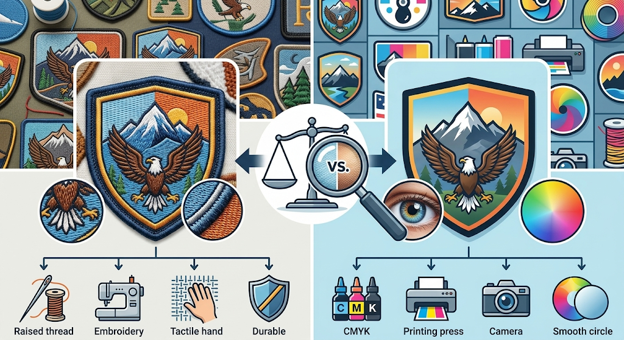
Two patches can carry the exact same logo and still look completely different once they arrive. One has a raised, stitched texture that catches the light. The other lies flat against the fabric with sharp, photo-like colour. The difference comes down to how each patch is made, and that choice affects everything from how the design looks to how long it lasts on a jacket, cap, or uniform.
If you have been searching for how embroidered patches compare with printed patches, or you are simply trying to understand the wider world of patch types before placing an order, this guide walks through the manufacturing process, the look and feel, the cost, the durability, and exactly which option fits which project. By the end, you will know precisely what to ask for when you request a quote.
Embroidered vs Printed Patches
Embroidered patches are made by stitching coloured thread onto a fabric backing, which creates a raised, textured surface that feels premium and holds up to years of wear.
Printed patches are created by transferring a digital design directly onto fabric or PVC using dye-sublimation or heat-transfer printing, which produces a flat, smooth finish with photo-realistic colour and fine detail that thread cannot replicate.
In short: choose embroidery for bold logos, text, and a classic tactile finish, and choose printing for gradients, photography-style artwork, and designs with dozens of colours.
What Are Embroidered Patches?
Embroidered patches are produced by stitching thread, usually rayon or polyester, onto a twill or felt backing using a computerised embroidery machine. The machine follows a digitised version of your artwork, building up the design stitch by stitch until the thread fully covers the visible surface of the patch.
This process gives embroidered patches their signature raised, tactile texture. Because the design is built from thread rather than ink, fine gradients and tiny text are harder to reproduce, but bold logos, block lettering, and simple shapes come out crisp, durable, and unmistakably premium.
Embroidery works particularly well for custom embroidered patches used on uniforms, workwear, motorcycle jackets, and varsity apparel, where the raised finish signals quality and the stitching stands up to years of washing, sun exposure, and everyday wear.
What Are Printed Patches?
Printed patches skip the needle entirely. Instead, the design is transferred onto the patch surface using dye-sublimation printing or digital heat-transfer, where ink is infused directly into the fabric fibres or bonded onto a PVC-style base. The result is a completely flat patch with no visible thread and no texture.
Because printing applies colour the same way a printer applies ink to paper, it can reproduce photographs, gradients, shading, and complex multi-colour artwork with a level of detail embroidery simply cannot match. There is no practical limit on the number of colours, which makes printing the go-to choice for intricate logos, sponsor artwork, and event merchandise.
Brands that need extremely fine detail alongside embroidered elements often turn to custom print embroidery, a hybrid approach that combines printed detail with stitched borders or accents for a design that neither method could achieve alone.
Embroidered vs Printed Patches: Key Differences
The table below breaks down how the two patch types compare across the factors that matter most when you are placing an order.
| Feature | Embroidered Patches | Printed Patches |
|---|---|---|
| Texture | Raised, tactile, 3D stitched surface | Flat, smooth, no visible texture |
| Colour detail | Best for solid colours and bold shapes | Excellent for gradients, photos, fine detail |
| Colour limit | Typically 6-12 thread colours | Unlimited colours, full-colour artwork |
| Durability | Very high; resists fraying and fading | Good, though prints can fade faster outdoors |
| Best for | Uniforms, logos, text, brand marks | Detailed artwork, sponsor logos, event badges |
| Typical cost | Slightly higher due to thread and labour | Often more cost-effective for detailed designs |
| Classic look | Traditional, premium feel | Modern, crisp, photo-realistic |
Patch Types Explained: Where Embroidered and Printed Fit In
Embroidered and printed patches sit within a much wider family of patch styles, and understanding where different Types of Custom Patches fits makes it easier to pick the right one for your project.
Chenille Patches
Chenille patches use thick, looped yarn to create a soft, fuzzy, varsity-style finish. They are the boldest option on this list and work best for large lettering on jackets and jerseys. You can see how they compare to other stitched styles in our breakdown of custom chenille patches, which are typically reserved for statement designs rather than fine detail.
PVC and Silicone Patches
PVC patches are moulded from soft rubber-like material and are naturally waterproof, making them popular for outdoor gear, tactical wear, and marine apparel. Because colours are poured into moulded sections rather than stitched, custom PVC patches can achieve vivid, saturated colour without the fading risk that some printed fabric patches face outdoors.
Woven Patches
Woven patches sit between embroidery and printing. Fine polyester threads are woven into a tight, flat design, which allows for more detail than standard embroidery while still keeping a textile feel. They suit logos with small text or thin lines that would otherwise get lost in thick stitching.
3D Embroidered Patches
3D embroidery vs regular embroidery patch give off a slightly different look and texture. 3D or puff embroidery adds foam underneath the stitching so raised sections stand higher off the fabric, giving text and logos extra dimension. If you are deciding how much texture your design actually needs.
Durability and Longevity Compared
Both patch types are built to last, but they age differently depending on how and where they are used.
- Embroidered patches resist fraying, cracking, and colour loss for years, even through repeated washing, because the colour lives inside the thread rather than on the surface.
- Printed patches hold detail beautifully but can be more sensitive to prolonged direct sunlight and harsh industrial washing, since the ink sits on top of the fabric rather than within it.
- For patches destined for heavy outdoor use, a PVC printed patch tends to outperform a fabric-printed patch, since the moulded rubber base is naturally weatherproof.
- For uniforms and workwear that face frequent laundering, embroidery remains the more forgiving, longer-lasting choice.
Design Detail and Colour Accuracy
If your logo relies on gradients, drop shadows, or photographic elements, printing will always capture that detail more faithfully than thread can. Embroidery, by contrast, simplifies artwork into clean blocks of colour, which is exactly why it looks so sharp on bold, simple brand marks but struggles with fine text under a certain size.
A useful rule of thumb: if your design would still look good as a two-colour silhouette, embroidery will suit it well. If the design depends on shading, blending, or more than a dozen colours to read correctly, printing is the safer route.
Cost Comparison
Pricing depends on size, quantity, and complexity, but the two methods tend to follow different cost patterns.
| Factor | Embroidered Patches | Printed Patches |
|---|---|---|
| Setup cost | Digitising fee per design | Minimal to no digitising required |
| Cost driver | Stitch count and thread colours | Design complexity has little cost impact |
| Best value at scale | Simple logos, large orders | Highly detailed designs, any order size |
| Small orders | Cost-effective for simple marks | Cost-effective for full-colour art |
Which Patch Type Should You Choose?
Matching the custom patches uk style to the use case is the fastest way to avoid a reorder. Here is a quick reference for common projects.
| Use Case | Recommended Patch Type |
|---|---|
| Company logo on workwear | Embroidered |
| Event or festival badge with a photo-style design | Printed |
| Motorcycle club or biker jacket patch | Embroidered or chenille |
| Outdoor, tactical, or marine gear | PVC printed |
| Sports team crest with fine detail | Woven or printed |
| Varsity jacket lettering | Chenille |
| Sponsor logos with gradients | Printed |
Attachment Methods: Sew-On vs Iron-On
Regardless of whether you choose embroidery or printing, you will also need to decide how the patch attaches to fabric. Sew-on patches offer the most permanent, heavy-duty hold and suit uniforms and workwear that face regular washing, while iron-on patches are quicker to apply and work well for retail products, promotional giveaways, or lighter-use apparel. Velcro backing is also available for patches that need to be swapped between garments regularly.
Care and Maintenance Tips
- Wash embroidered patches inside out on a gentle cycle to protect the raised stitching.
- Avoid tumble drying printed patches on high heat, as prolonged heat can dull ink over time.
- Keep PVC patches away from prolonged direct sunlight if colour vibrancy is a priority, even though the material itself is weatherproof.
- Iron-on patches should be reheated and pressed firmly if edges begin to lift after repeated washing.
- Store spare patches flat in a dry place to prevent creasing or thread snagging before use.
Frequently Asked Questions
Are embroidered patches more expensive than printed patches?
It depends on the design. Embroidery pricing is driven by stitch count and thread colours, so simple logos can be very affordable, while highly detailed designs are often cheaper to produce as printed patches since detail does not add significant cost.
Which patch type lasts longer, embroidered or printed?
Embroidered patches generally last longer under heavy washing and daily wear because the colour is woven into the thread itself. Printed patches last just as long in lower-wear settings, and PVC printed patches are especially durable outdoors.
Can printed patches include photographs or gradients?
Yes. Printing is the only method that reliably reproduces photographs, gradients, and shading, since the design is applied the same way ink is applied to paper rather than built from individual thread colours.
Do embroidered patches work for small, detailed logos?
Very small text or fine linework can lose clarity in embroidery once stitches get too thin to hold their shape. For logos with small detail, woven or printed patches usually reproduce the design more accurately.
What is the difference between printed patches and woven patches?
Printed patches use ink applied to a fabric or PVC surface, giving a completely flat, smooth finish. Woven patches use very fine thread woven into a tight flat design, giving slightly more texture than a print while still capturing more detail than standard embroidery.
Which patch type is better for outdoor or waterproof use?
PVC patches, whether printed or moulded, handle moisture and outdoor conditions better than fabric-based embroidered or printed patches, making them the preferred choice for tactical gear, marine wear, and outdoor equipment.
Can I combine embroidery and printing on the same patch?
Yes. Hybrid patches use printing for detailed sections of a design and embroidery for borders, text, or accents. This is typically offered through custom print embroidery services and is a popular option for brands that want fine detail without losing the tactile edge stitching provides.
How do I decide between embroidered and printed for my brand?
Start with your artwork. If your logo is bold, simple, and uses a handful of solid colours, embroidery will give you a premium, durable finish. If your design relies on gradients, small text, or more than a dozen colours, printing will reproduce it far more accurately.
Choosing the Right Patch for Your Brand
Neither embroidered nor printed patches are universally better. Embroidery delivers a raised, premium texture built to withstand years of wear, while printing captures fine detail and colour that thread physically cannot replicate. The right choice comes down to your artwork, your budget, and where the patch will actually be worn.
If you are still weighing up materials, backings, and borders alongside this decision. Whichever style fits your design, working from a clear brief on colour count, size, and end use along with choosing the manufacturer like The Custom Patches UK will help you land on the patch that looks right and lasts the longest.