
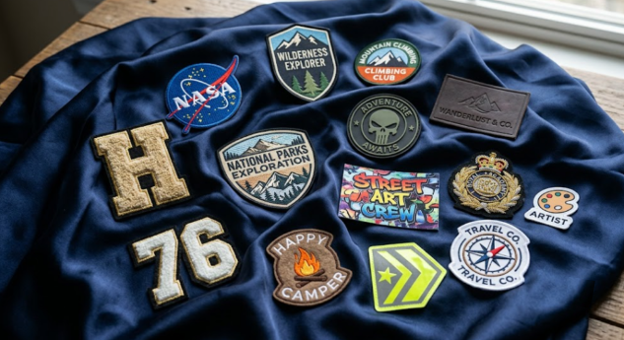
If you have searched for custom patches UK, you have probably noticed just how many options are on the table. Embroidered or woven? Iron on or sew on? Velcro or a straight border?
At The Custom Patches UK, we produce custom embroidered patches, custom printed patches, custom PVC patches and more for businesses, schools, sports clubs, motorcycle groups, uniform suppliers and individuals right across England, Scotland, Wales and Northern Ireland.
This guide walks through every type, material, size, border, backing and care instruction you need, along with a clear breakdown of how ordering actually works, from free mockup to final delivery.
Whether you are ordering a single personalised patch for a jacket or commissioning thousands of badges for a uniform rollout, this guide will help you make an informed decision before you request a quote.
What Are Custom Patches?
A custom patch is a small piece of fabric, plastic or leather, decorated with a design, logo or text, and finished with a backing that allows it to be attached to clothing, bags, caps or equipment.
Custom patches have been used for military insignia, scouting badges, motorcycle club colours, corporate uniforms and fashion branding for well over a century, and the manufacturing process has changed remarkably little at its core, even though digitisation, laser cutting and full-colour printing have made the finished product far more precise.
In the UK, custom badges and patches are commonly used by:
- Businesses branding staff uniforms, workwear and merchandise
- Schools, cadet forces and scout groups
- Motorcycle clubs and biker gangs
- Football, rugby and cricket clubs
- Event organisers producing commemorative patches
- Individuals customising denim jackets, backpacks and gilets
Types of Custom Patches: Definitions, Pros and Cons
There is no single “best” patch type. The right choice depends on your design complexity, budget, and where the patch will be worn. Below is a breakdown of the main types we produce.
Custom Embroidered Patches
Design stitched with coloured thread onto a twill backing fabric, either 50%, 75%, or 100% thread coverage. Also available in 3D embroidered versions.
Pros
Classic raised textured look, extremely durable, ideal for logos and text.
Cons
Fine detail and small text can lose clarity below a certain size.
CUSTOM WOVEN PATCHES
Made using much finer and thinner threads woven tightly together on a loom rather than stitched.
Pros
Sharp detail, crisp lines, better for small text and intricate logos.
Cons
Slightly higher cost, flatter texture than embroidery.
Custom Printed Patches
Design is dye-sublimated or screen printed directly onto a fabric base, then edge-stitched.
Pros
Handles photographic detail, gradients and unlimited colours.
Cons
Less tactile than embroidery, colours can fade faster in direct sun
Custom PVC Patches
Designed and moulded from soft rubber-like PVC into a raised, three-dimensional shape.
Pros
Waterproof, scratch-resistant, ideal for outdoor and tactical gear.
Cons
Not breathable, heavier than fabric options, and higher minimum design complexity.
Custom Chenille Patches
Made using thick, looped yarn for a fuzzy, varsity-style texture.
Pros
Bold, eye-catching, traditional letterman and varsity aesthetic.
Cons
Bulky, not suited to small or detailed designs.
Custom Leather Patches
Design debossed, engraved or printed onto genuine or faux leather.
Pros
Premium look, long-lasting, popular for caps and bags.
Cons
Higher price point, limited colour range compared with embroidery.
For most business and club orders, embroidered patches remain the most popular choice because they balance cost, durability and appearance. If your design includes fine text, colour gradients or photographic detail, woven or sublimated/printed patches are usually the better fit.
Additionally, custom appliqué patches and custom silicone patches are also popular among individual artists and startups focusing on trendy fashion wear. They provide enhanced personalisation options to make imaginations a reality.
Materials Used in Patch Manufacturing
- Twill fabric: the standard base for embroidered and woven patches, chosen for its strength and smooth surface
- Polyester embroidery thread: colourfast, durable and available in an extensive colour range
- PVC/soft rubber: used for tactical and outdoor patches that need to resist water and abrasion
- Chenille yarn: thick cotton or acrylic yarn used for varsity and letterman-style patches
- Genuine and faux leather: used for premium cap patches and branded goods
- Felt: a lower-cost backing sometimes used for craft and hobby patches
Custom Patch Sizes: A Quick Reference
Patch size is usually measured by the longest edge, in inches or centimetres. Here is a guide to common sizes and their typical uses.
| Size | Typical Use |
| Under 2 inches (5 cm) | Name tags, small emblem patches, cap badges |
| 2 to 3 inches (5 to 7.5cm) | Chest logos, sleeve badges, club emblems |
| 3 to 4 inches (7.5 to 10cm) | Standard front logo patches, event badges |
| 4 to 6 inches (10 to 15cm) | Back patches for jackets, larger team crests |
| Over 6 inches (15cm) | Full back patches for biker vests and outerwear |
There is no fixed minimum or maximum, and our team can produce custom size patches to match your exact specification, including irregular and die-cut shapes.
Patch Shapes and Borders
Beyond the standard circle, square and shield, we can produce custom die-cut patches in any custom outline, from a company logo silhouette to a mascot shape. Border finishing affects both appearance and durability:
- Merrowed border: a rolled, stitched edge that is the most common and most durable finish, ideal for round, oval and simple shapes
- Hot cut/laser cut border: the edge is heat-sealed flat against the backing, allowing for intricate, irregular shapes without a visible rolled edge
- Border colour matching: borders can be colour-matched to your design or contrasted for visual impact
Backing Options Explained
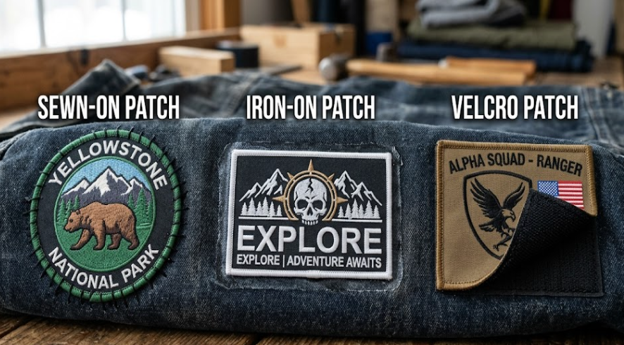
Choosing the right backing option is just as important as choosing the patch type, since it determines how the patch is attached and how permanent that attachment is.
| Backing | Best For | Removable? |
| Iron on/heat seal | Quick DIY application on cotton, denim and polyester | No, semi-permanent |
| Sew on | Long-term wear with durability, uniforms, heavy-use garments | No, permanent |
| Velcro (hook and loop) | Tactical gear, uniforms requiring interchangeable badges | Yes |
| Self-adhesive/peel and stick | Temporary or one-time-use for hard surfaces | Yes, but not durable long-term |
| Pin or clutch back | Lapels, hats, promotional giveaways | Yes |
| Magnetic backing | Delicate fabrics that cannot be pierced or ironed | Yes |
If you are unsure which backing suits your fabric, our team offers free guidance before you place your order, and combination backings such as Velcro patches with a sew-on border reinforcement are available on request.
Caring for Your Custom Patches
Proper care extends the life of any patch considerably, and the correct method depends on the backing and material.
- Washing: turn garments inside out before machine washing on a cool, gentle cycle. Avoid fabric softener on embroidered patches, as it can dull the thread over time.
- Ironing: never iron directly over an existing patch on high heat, since this can melt PVC or loosen adhesive backing. Use a pressing cloth if ironing nearby.
- Drying: air dry where possible. Tumble drying on high heat is the leading cause of iron-on patches lifting at the edges.
- Storage: store spare or removed patches flat, away from direct sunlight, to prevent thread fading and PVC discolouration.
- Reapplication: if an iron-on patch begins to lift, reapply heat with a pressing cloth for 15 to 20 seconds, or have it reinforced with a few stitches around the border.
How to Order Custom Patches: Step by Step
- Send your design or idea: upload artwork, a logo file, or simply describe what you want. Our design team can build a design from scratch if you do not have finished artwork.
- Choose type, size, backing and border: our specialists will recommend options based on where the patch will be worn and your budget.
- Receive a free digital mockup: you will see a proof of your patch before anything goes into production, and revisions are included at no extra charge.
- Approve and confirm quantity: once you are happy with the mockup, confirm your order quantity, whether that is a single patch or several thousand.
- Production: your patches are manufactured to the approved specification, with quality checks at each stage.
- Delivery: patches are shipped across the UK, with tracked delivery options available for both no minimum order quantity and bulk wholesale orders.
Free Mockups and Design Support
Every order at The Custom Patches UK includes a free mockup before production begins, so you never commit to a design you have not seen. If you do not have print-ready artwork, our in-house designers can convert a rough sketch, a low-resolution logo, or even a written description into production-ready patch art. Revisions are included until you are satisfied, and there is no obligation to proceed after seeing your mockup.
Bulk Orders and No Minimum Orders
We understand that patch orders come in every size, from a single collector’s badge to a five-thousand-piece uniform rollout, and our pricing structure reflects that.
- No minimum order: order a single custom patch with no quantity requirement, ideal for gifts, samples or personal projects
- Bulk patch orders: per-unit pricing drops significantly at higher quantities, making large orders for schools, event organisers and corporate uniform suppliers considerably more cost-effective
- Reorders: your design and digitised embroidery file are kept on record, so reordering the same patch later does not require a new setup fee in most cases
- Mixed orders: combine different sizes, backings or colourways within a single bulk order where needed
Whether you need ten patches or ten thousand, our team will provide a transparent quote with no hidden setup costs.
Choosing the Right Patch Type for Your Project
With six patch types on offer, picking the right one comes down to three questions: how detailed is your design, where will the patch be worn, and what is your budget per unit. A simple text logo for a workwear jacket rarely needs the cost of woven or PVC production, so embroidered patches are usually the sensible default.
If your artwork includes a gradient, a photograph, or very small lettering that needs to stay legible, printed or woven patches will hold that detail far better than standard embroidery.
For outdoor kit, tactical gear or anything that needs to survive rain, mud and repeated washing, PVC is worth the extra cost. Chenille suits varsity jackets and heritage branding rather than corporate uniforms, and leather is generally reserved for premium cap and accessory ranges where the finished cost per unit is less of a concern.
It is also worth thinking about scale. A one-off patch for a personal jacket allows more flexibility with material choice, since cost per unit matters less. A run of several hundred or several thousand patches for a uniform programme changes the calculation considerably, and our team will always flag where a cheaper material or backing achieves a near-identical result at a lower overall cost.
Design Tips for Print-Ready Patch Artwork
A clean starting file makes the difference between a patch that looks crisp and one that loses detail in production. A few points to keep in mind before you send artwork over:
- Vector files work best: formats such as AI, EPS or SVG produce the cleanest embroidery digitisation, though a high-resolution JPG or PNG will also work
- Keep text above the minimum size: lettering under roughly 3 mm tends to blur in embroidery, so anything smaller is usually better suited to woven or printed production
- Limit colour count for embroidery: while there is no hard cap, designs with a smaller, well-defined colour palette translate more cleanly into thread than complex gradients
- Consider contrast: dark thread on a dark garment, or light thread on a light garment, can lose visual impact, so contrasting colours generally read better at a distance
If your existing logo file does not meet these standards, our design team can rework it into patch-ready artwork as part of your free mockup at no additional cost.
Frequently Asked Questions
How long does it take to receive custom patches in the UK?
Standard production typically takes 7 to 10 working days, followed by 1 to 3 days for UK delivery, though rush options are available for urgent orders.
Is there a minimum order quantity?
No, we accept orders starting from a single patch, with better per unit pricing available at higher quantities.
Can I see my patch before it is made?
Yes, every order includes a free digital mockup for review and approval before production begins.
What is the difference between embroidered and woven patches?
Embroidered patches use thicker thread for a textured finish, while woven patches use finer thread for sharper detail and cleaner small text.
Which backing is best for a jacket I plan to wear often?
Sew-on backing is the most durable choice for frequently worn garments, though a reinforced iron-on patch also holds up well.
Do you offer design help if I do not have finished artwork?
Yes, our design team can create patch-ready artwork from a sketch, description or low-resolution logo at no extra cost.
Order Your Custom Patches Today
Custom patches UK remain one of the most versatile and cost-effective ways to brand a uniform, mark a club, or personalise a jacket, and getting the type, material, size, border and backing right makes a real difference to how the finished patch looks and how long it lasts.
The Custom Patches UK produces embroidered, woven, printed, PVC, chenille and leather patches with a free mockup, no minimum order requirement, and full support from design through to delivery anywhere in the UK. Contact us for a free quote today!